


The Cloth Nappy Incentive Scheme continues to be busy, with two launches having taken place in December and January

In 2025 the Cloth Nappy Incentive Scheme proved popular with new parents across Munster. This year we have built on the sucess of last year and have expanded into Tipperary and Dublin.
How it works
The aims of the scheme are to support the use of reusable nappies in families that would otherwise have used disposable nappies, and to normalise the use of reusable nappies. Each participating family recieves reusabale nappies, inserts and cloths in a bundle. This bundle is more than enough to start a family on a reusable nappy journey.
In Ireland 1.2 million disposable nappies go into landfill every day
This scheme has partnered with the Cloth Nappy Library Ireland (CNLI) who will offer support to parents taking part through online workshops on the use of the nappies and through facilitating a WhatsApp group and Facebook group on reusable nappy use.
Participating families in previous years of the scheme have taken part in a survey on their experiences of the scheme to see if it is achieving these aims. Key findings from the participants in the Munster 2023/24scheme are that 76% of participating households more than halved their reliance on disposables, over 90% of participants stated that they are likely to continue using cloth nappies and over 80% of participants stated that they would recommend cloth nappies to other parents.
What's happened in 2026
In December I was in Tipperary University Hospital in Clonmel to launch the Tipperary Scheme. I met with Tipperary County Council staff from the environment department as well as midwives from the hospital, where the scheme is being promoted by midwives in the antenatal clinic and postnatal ward.
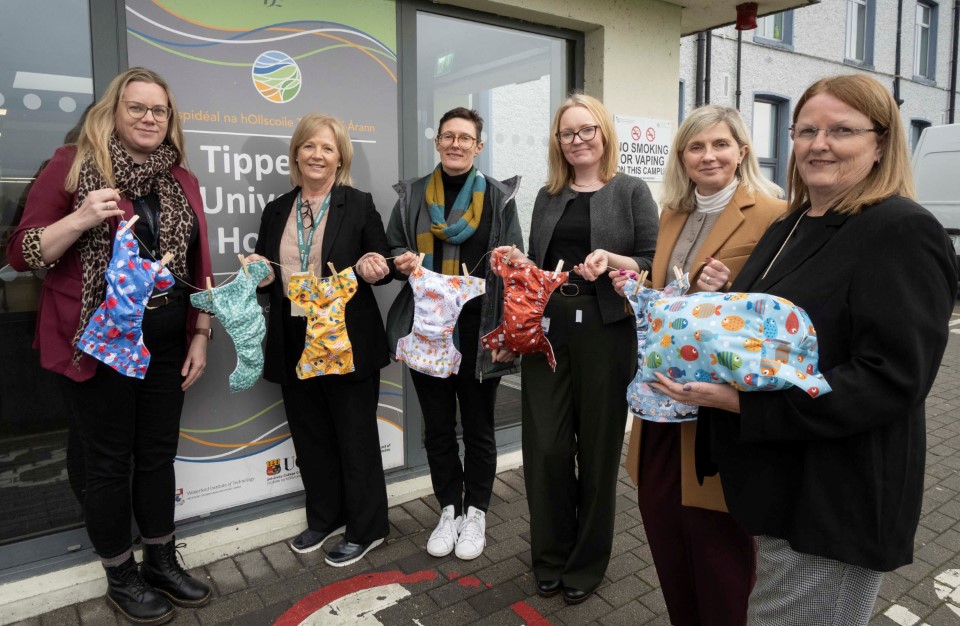
Fiona Flynn, Staff Officer, Environment and Climate Action Section, Tipperary County Council commented, “Making the switch to cloth nappies is a meaningful change that can have a big environmental impact. We encourage parents across Tipperary to take this opportunity to avail of free starter kits and experience the benefits of reusable nappies”.
Maggie Dowling, Director of Midwifery, Tipperary University Hospital added, “We are delighted to support the Cloth Nappy Incentive Scheme. It’s a practical way for families to reduce waste and embrace sustainability while saving money. This initiative reflects our commitment to sustainability and patient wellbeing.”
Dublin takes action
In January I was also in North Clondalkin Library for the launch of the South Dublin County Council (SDCC) Scheme. Clondalkin is the designated Decarbonising Zone (DZ) for SDCC. A decarbonising zone is an area selected by a local authority as a key area for climate action. For this reason the Cloth Nappy Incentive Scheme was introduced for parents within the DZ. With the latest Life Cycle Analysis (DELFT, 2025) on nappy choices showing that per nappy change disposable nappies create 2.8 times more CO2 than reusable nappies, switching to reusable nappies is one way families can reduce their carbon footprint as well as reduce waste.

Gary Tyrrell, SDCC Climate Action Officer said
"Reducing waste is a pillar of the South Dublin Climate Action Plan. By moving toward a circular economy model for baby care, we are directly addressing waste in a practical, scalable example of how local action can lead to significant carbon savings and environmental protection."
The scheme is being promoted by the library, and residents of Clondalkin are invited to apply for their free cloth nappy and wipes starter bundle. The launch in North Clondalkin Library was attended by local families as well as SDCC environment staff and Area Chair Councillor Caroline Brady and Councillor Shirley O'Hara.
Councillor Caroline Brady said "I was delighted to launch this initiative in North Clondalkin. As a Council, we are committed to supporting our residents in making sustainable choices that are not only good for the planet but good for the pocket. This scheme is about more than just nappies, it’s about building a supportive community that looks after our environment and our future generations."


