


Irish local and national decision-makers finally catch up on circular fashion

2026 is starting to look like the year Ireland takes up the fight against fast fashion seriously, giving hope to anyone advocating for sustainable and circular fashion in Ireland.
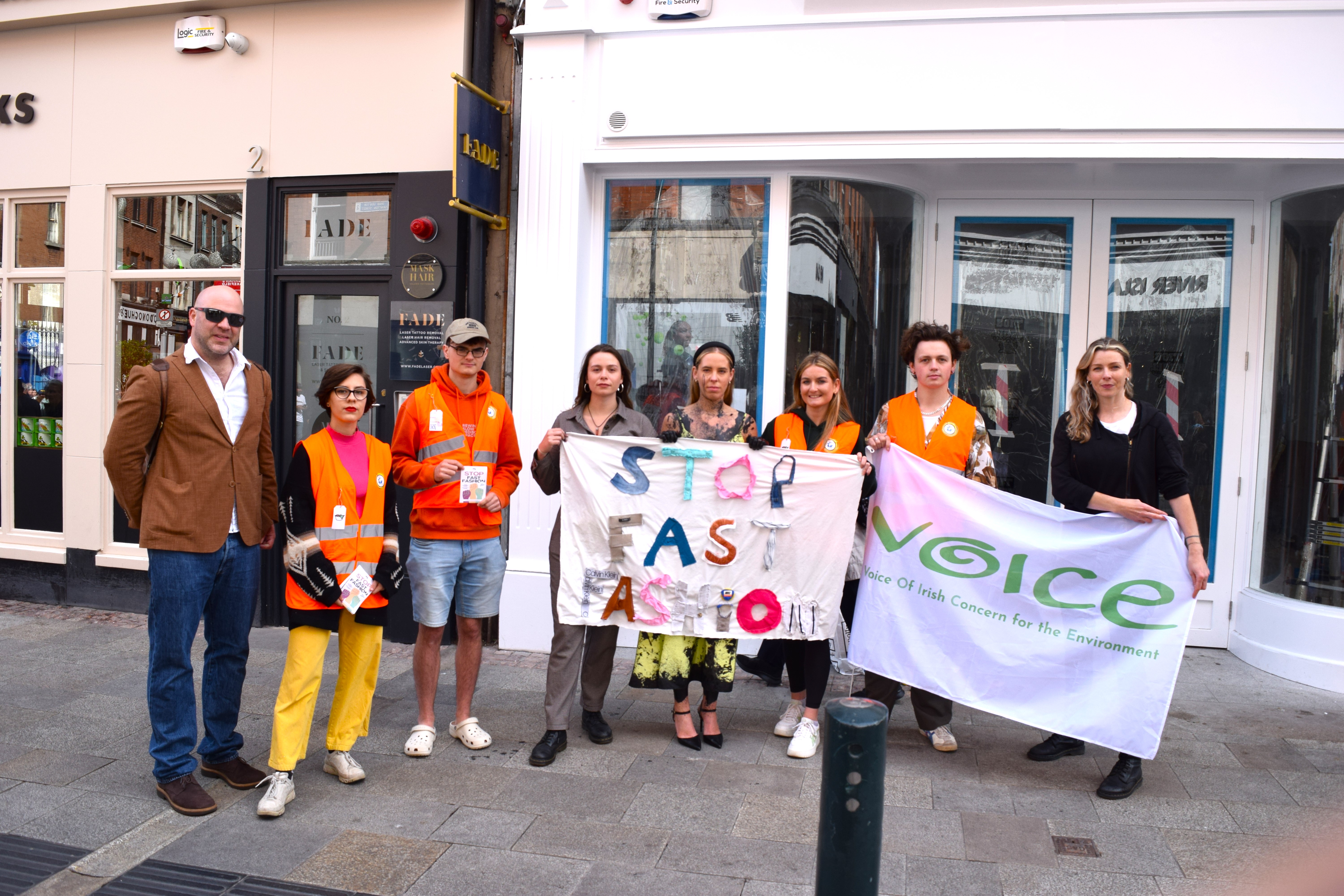
This month, two major developments signal that things are beginning to shift: both on the ground and at policy level. For us at VOICE Ireland, it’s an encouraging sign that years of advocacy are starting to resonate with decision-makers.
We’re not there yet, but we are moving.
A new era for textile collection in Dublin
You might already have noticed a change in your local textile bring bank. That’s because Dublin City Council has awarded a new contract for its textile collection network to Enable Ireland.
This is more than a simple change of operator; it is a meaningful shift in how textile collection is managed and monitored.
Enable Ireland, a long-standing charity with experience in reuse through its shops and bring banks, will now operate the network under a new four-year tender starting April 2026. Not only will profits support their charitable missions, bringing awareness and supporting people with disability across the country; but the contract introduces something we have long called for: transparency.
Of the textiles collected, Enable Ireland estimated a 15% resale capacity through their national network of charity shops. The rest will be passed on to partners like Cookstown Textile Recyclers, where they are sorted into hundreds of categories and redistributed globally.
But for the first time, the Enable Ireland and his partners were required to clearly outline:
· How collected clothes are being sorted.
· Where collected textiles are going, includingexported ones.
· Who handles them along the value chain
· What their final destination and fate will be
This is a major step forward. Textile collection has operated as a black box for years, with major limitations in theinformation provided by companies towards the destination and fate of clothing.
Our 2025 investigation Threads of Truth highlighted the issue with 95% of clothing deposited intextile banks and take back schemes leaving the country and 52% of tracked clothes ending up with an unclear fate.
The tender also focused on providing operational improvements, such as daily monitoring of sites and responsible waste management (small but essential steps toward a more accountable system).
We would like to see that all newly introduced criteria for awarding tenders to textile collectors should be taken into consideration by all LAs. Choosing non-profit charitable organisation is also a great way to support local reuse and avoid any profit-driven incentive to miscategorise items to get more out of them.
A national roadmapthat acknowledges the real issues
Alongside these local changes, the Irish government has released a new national policy statement and roadmap for circular textiles.
Its ambition is clear: to “set a clear policy direction for how Ireland can realise its potential for a more circular and sustainable economy in textiles.”
And for the first time, it reflects many of the messages we’ve been pushing for years.
After nearly three years contributing to the Textile Advisory Group, VOICE Ireland is particularly encouraged to see recognition of two key realities:
· The need for full transparency in textile flows, exports, and end-of-life
· The urgency of addressing root causes, including fast fashion and overconsumption
The roadmap explicitly acknowledges that awareness campaigns alone are not enough. It calls for deeper engagement with producers and even proposes exploring economic instruments to tackle fast fashion and overproduction.
It also sets a powerful objective: to normalise responsible consumption and production by addressing today’s high-consumption business model.
This is a bigshift. It shows a growing understanding that circularity cannot exist withoutreducing volumes.
Encouraging progress,but not the finish line
So, is thework done?
Not even close.
While these developments are promising, they remain, for now, largely commitments and frameworks. The real challenge lies in implementation.
We are still missing clear answers on:
· How exactly fast fashion will be regulated
· How far policymakers are willing to go in challenging growth-driven business models
· What enforcement and follow-up will look like to ensure exported clothes are being reused or recycled across the globe.
Even within existing systems, challenges remain. For example, Changing Markets Foundation previously highlighted issues in global textile reuse chains, including the quality and fate of exported clothing. A 2023 assessment of bales linked to Cookstown Textile Recyclers found that a significant portion of items were low quality with a risk of it ending up as waste if they were not sold.
“A bale bought by ‘Joseph’ in Kawangare Market,(Nairobi) mitumba market, for 10,000 Kenyan Shillings (€78) found that in one bale, 202 items could be graded as first and second camera, whereas 173 (46%) items were low grade and would be sold cheaply at a daily discount before going to waste. Overall, 121 (32%) items were low-grade branded items, including clothing from Adidas, [...] Primark Cares, Red Herring and Shein, and most, ifnot all, of these items contained high proportions of synthetics. Joseph estimated that he would make 3,000 KES profit on the bale (€23).”
This underscores a crucial point: transparency must lead to accountability.
An opportunity to build a fair industry
These new requirements open the door to something we've been calling for: integrating global justice into Ireland’s circular textile system.
One key opportunity lies in Extended Producer Responsibility (EPR), where producers pay for the end-of-life management of their products.
With improved traceability, we can begin to imagine:
· EPR fees that follow garments across borders
· Financial support reaching the actors who actually handle reuse and waste
· Greater stability for informal and vulnerable workers in global resale markets
This could fundamentally reshape the system if done right.
VOICE Ireland’s rolein the next chapter.
These developments give us a solid foundation to build on. In 2026, VOICE Ireland is launching new projects focused on prevention because circularity starts with using less.
We will be:
· Supporting local initiatives already driving reuse and reduction
· Working with communities and stakeholders, including in Carlow Town, to develop holistic approaches
· Engaging both circular and mainstream actors to push for systemic change
This is where the concept of sufficiency becomes relevant to rethinking not just how we consume, but how much.
Conclusion
This month shows that change is possible. Dublin City Council’s new approach to textile collection and the national roadmap both reflect years of advocacy, collaboration, and persistence.
At VOICE Ireland, we’re proud to see these ideas take root.
Now, the realwork begins.
Sources:
https://www.dublininquirer.com/dubliners-get-a-bit-more-transparency-around-where-some-old-clothes-end-up/
https://cdn.prod.website-files.com/606dd3f38acbf3d553ac017d/69a9bf0bbed8c48fc75052c2_a72c77f42232abe1941fb601b918e2cd_Threads%20of%20Truth%20report%202025%20Final.pdf
https://www.documentcloud.org/documents/28031772-textile-service-april-2026-1/?ref=dublininquirer.com
https://changingmarkets.org/wp-content/uploads/2023/02/CM-Trashion-online-reports-layout.pdf


