


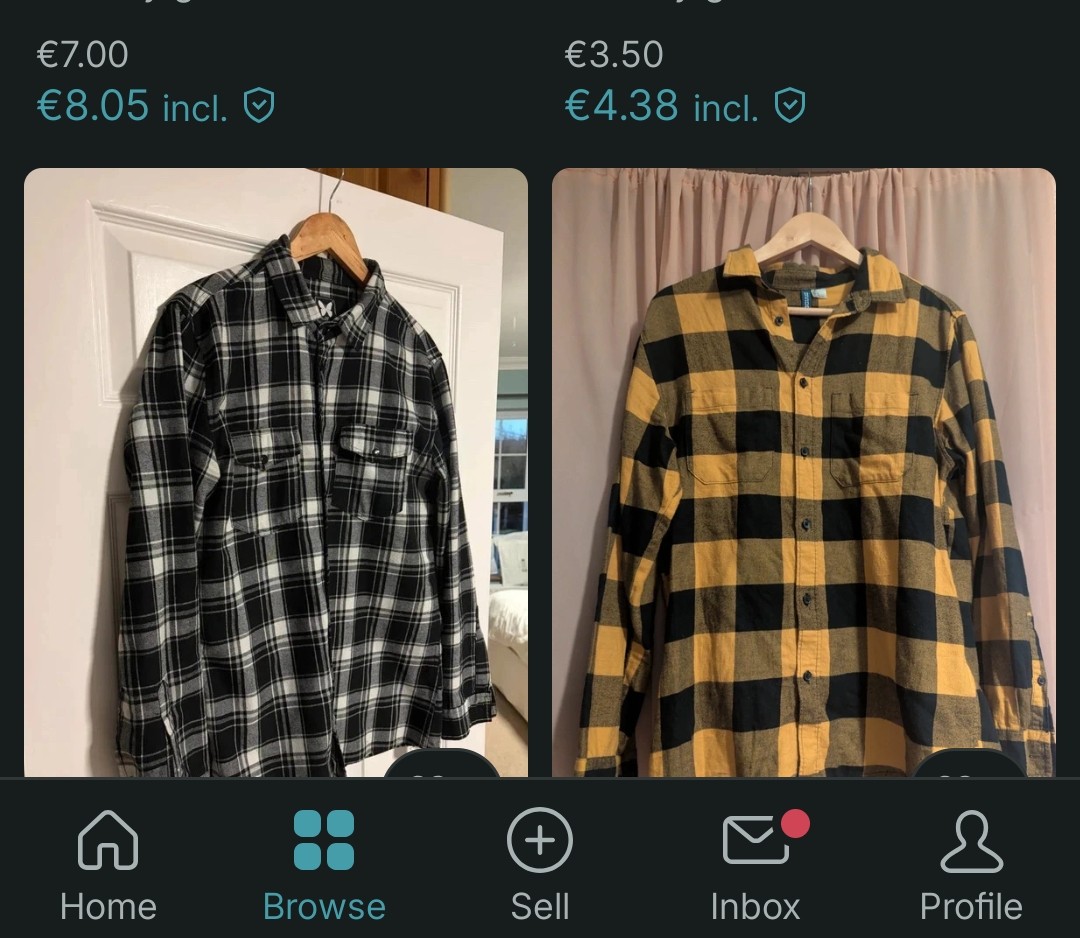
This week, Vinted Ireland officially opened itself to trading beyond France: since Monday, Irish members can also buy from and sell to members in Belgium and Luxembourg.¹

Vinted has become a phenomenon in these countries since the Lithuanian second-hand platform, founded in 2008, launched in France in 2013. France is its largest market, with an estimated 23 million users.² Ireland is catching up fast since Vinted arrived here in 2024. AIB card data showed spending on second-hand platforms such as Vinted up 197% year on year.¹ By opening up to Belgium and Luxembourg, Vinted is giving this rapidly growing Irish customer base a much wider pool to shop from.
Often presented as a sustainable fashion champion, Vinted has nonetheless faced growing criticism for its over-greenified image. So let’s unpack the virtues and hidden flaws of Vinted, and of online second-hand shopping more broadly.
First, there is one undeniable virtue to Vinted’s expansion. It makes second-hand shopping widely accessible and brings circular behaviours to a much larger scale. It also removes some of the barriers and stigma that second-hand shopping might still carry. People who exclusively shop online get the full app experience: you can chat to the seller and ask questions, which makes it “safer” to choose an item that has a better chance of fitting you. It also opens up a huge catalogue, which matters for rural shoppers whose local options can be limited. That gives access to so many styles, sizes and brands, for all budgets too.
At VOICE, we deliver workshops and work with loads of different groups. When we talk about circular fashion with people of all ages, many of them mention Vinted. This shows the platform is helping people understand and visualise what circular fashion is. A lot of young people also become more aware of the quality and care of items when they buy and/or sell. They become responsible for the state of the clothes they sell, and they quickly realise that ultra fast fashion is particularly hard to resell, because it simply doesn’t have much value. This reality check often stays hidden when we donate our clothes to charity shops and expect them to be reused or resold, and it highlights a few issues in the second-hand sector.
Indeed, charity shops have been at the forefront of dealing with the consequences of fast fashion and fast consumption patterns.
More often than not, people offload huge amounts of disposable clothes bought from ultra fast fashion brands. Charity shops are overwhelmed by the rising costs of sorting these clothes and by unsold stock that nobody wants. In turn, shoppers complain about how many fast fashion pieces now fill these shops, and miss the good old thrifting aspect of charity shopping.
And to some, Vinted is making that phenomenon worse. People sell their quality pieces online, and send the ones that aren’t even worth the package they’d be posted in to charity shops. In France, the charity Emmaüs has already said publicly that the quality of donations is dropping, because people give them what they couldn’t sell on Vinted.³
That’s where we start to look a little behind the circular success story. Vinted is a great, accessible tool, but that’s what it is: a tool. Its sustainable impact depends heavily on how it is actually used, and it isn’t a magical solution that will stop fast fashion. Instead, Vinted has blended into the current fast fashion economy, with a limited impact on overall behaviours. In France, a study by the shopping app Joko found that 47% of Vinted customers also buy from Shein, and 28% from Temu.² Many people simply shift their fast consumption habits onto Vinted. The pace of acquiring and discarding is just as fast and unsustainable at its core. It is simply made to feel sustainable, and it doesn’t necessarily reduce purchases of brand-new items. On the contrary, it adds yet another outlet for the fabricated need for more.
In the end, fast fashion brands are still growing. Zara’s sales rose by about 1% in 2025 to just over €28 billion, while its parent group Inditex grew 3.2% overall.⁴ And in France, the postal service La Poste reported that Shein and Temu accounted for 22% of the parcels it handled, up from under 5% five years earlier.⁵
Finally, there’s a newer risk that blurs the line even further: dropshipping. Vinted is not only everyday people selling clothes they no longer use. There’s a growing numbre of sellers that buy new items in bulk from Shein, Temu or AliExpress and list them on Vinted as second-hand, often at two to five times the original price. Sometimes they use AI-generated photos to make the items look worn or vintage.⁶ Vinted’s rules ban commercial reselling and dropshipping, and the platform says it can hide listings or suspend accounts, but moderation struggles to keep up. In those cases, the “second-hand” label becomes just a new shop window for ultra fast fashion. The buyer, who believes they’re making the sustainable choice, ends up paying more for the very thing they were trying to avoid. So when you shop on Vinted, check the seller’s profile. Several identical items, brand-new pieces with tags in every size, or polished stock-style photos are good signs you’re not buying from someone’s wardrobe.
So, is Vinted sustainable?
Vinted, like many other circular businesses that have become global phenomena, should be seen for what it is: a tool. It can be used in virtuous ways, or it can reinforce the very trends it claims to challenge. To me, it’s a great example of how something labelled “circular” doesn’t necessarily end up solving the root problems. Fast fashion mindsets and consumption patterns aren’t really shifting. Instead, Vinted is slowly being added to the fast fashion shopping basket, at a time when fast fashion brands are finding it harder to keep providing the extremely cheap clothes they've been producing for years. The turnover is just as fast, and disposability is only being dealt with at the end of the chain. Charity shops and others across the globe end up paying the price.
So use Vinted, but use it well. Buy less and choose pieces that will last. Sell what you genuinely no longer wear rather than what you bought last month. Circularity only works if it slows us down, not if it simply gives us one more place to shop.
References:
- Irish Examiner, Vinted connects Irish members to two new countries, October 2026;
- Presse-Citron, Vinted a un mot pour les Français et les Françaises
- Modaes, Zara grows only 1% in 2025 but exceeds 28 billion in sales, March 2026; FashionNetwork, Inditex reported a net profit of €6.22 billion in 2025, with sales up 3.2% to just shy of €40 billi…, March 2026
- Europe 1, Les plateformes Temu et Shein représentent 22% des colis gérés par La Poste (in French), October 2024
- FashionUnited, Vinted: How dropshipping is blurring the promise of circularity, February 2026; Science Feedback, What you see is (not) what you get: genAI-powered scams on Vinted; Presse-Citron, « Ils achètent sur Shein et revendent 3 fois plus cher sur Vinted » : l’arnaque qui scandalise les …
- LSA, Vinted, décryptage en chiffres du 1er acteur de la mode et de la seconde main en France (in French); Europe 1, Vinted : les Français raffolent de la plateforme, les ventes en hausse de 32% en 2023FrenchWeb, La startup Vinted devient la première licorne lituanienne


